Multi-Tiered System of Support (MTSS)
Contact
Ginny McElhaney
Maura Bishop
865-828-5436
Links
For More Information on Positive Behavioral Intervention and Support (PBIS):
What is a Multi-Tiered System of Support (MTSS)?
Grainger County Schools MTSS Vision Statement
Every student thriving—academically, behaviorally, and equitably—through a unified system of support.
The Tennessee Department of Education’s strategic plan, Tennessee Succeeds, states our unifying vision: “Districts and schools in Tennessee will exemplify excellence and equity such that all students are equipped with the knowledge and skills to successfully embark upon their chosen path in life.” To achieve this vision, each school and classroom mustprovide students with opportunities to grow academically, socially, physically, and culturally.
Response to Intervention (RTI) is defined as “the practice of providing high-quality instruction and interventions matched to student need, monitoring progress frequently to make decisions about changes in instruction or goals, and applying child response data to important
educational decisions” (Batsche et al., 2005). In Tennessee, we implement a unique version of the RTI model that integrates the principles of quality instruction and intervention, called the Response to Instruction and Intervention (RTI2) Framework.
Academic and behavior deficits are related and have been identified and academics as significant predictors of outcomes once students leave the public education system. While RTI2 focuses on academic instruction and intervention, students also require instruction and intervention in behavior to be successful academically, as well as within their communities and later in postsecondary and careers. Tennessee’s new RTI2-B Framework unites evidence-based, problem-solving approaches to address student behavior. RTI2-B focuses on teaching students appropriate behaviors as opposed to punishing inappropriate behaviors and also develops positive relationships between students and school staff.
Similar to RTI2 for academics, RTI2-B includes universal prevention efforts within Tier I to promote a positive school- and class-wide climate. Through a focus on strong Tier I behavior supports, schools can create a culture where all students and teachers are respected and
included in their community.
With consistent and continued implementation of RTI2-B, schools can 2009)
expect:
• an increase in positive interactions;
• a positive school climate;
• a proactive approach to crisis;
• an increase in instructional time;
• an increase in leadership opportunities for staff, parents, and students;
• an increase in student academic achievement;
• a decrease in interruptions to learning;
• a decrease in chronic absenteeism;
• a decrease in the number of office discipline referrals; and
• a decrease in suspensions.
Ultimately, when implemented with fidelity, RTI2-B will provide more time for teachers to
teach, students to learn, and administrators to run their schools efficiently and effectively.
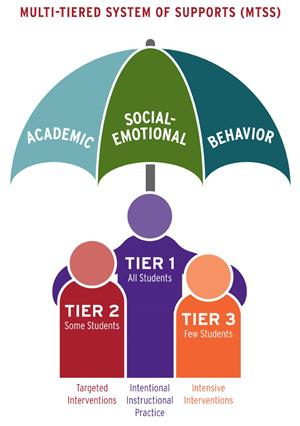
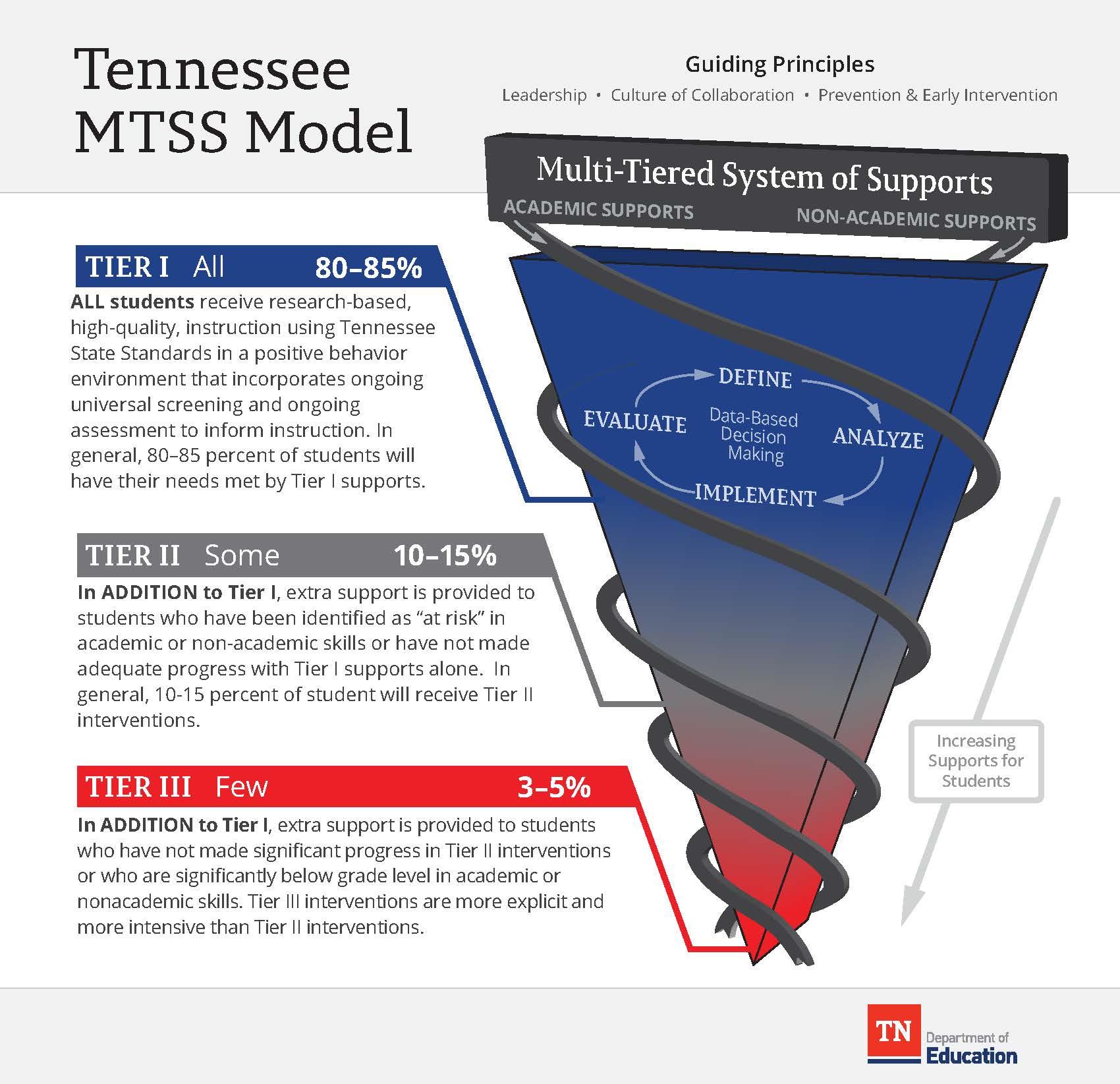
The RTI2-B Framework fits within a larger system of student supports. Researchers and practitioners call this a multi-tiered system of supports (MTSS), which is “the practice of providing high-quality instruction and interventions matched to student need, monitoring progress frequently to make decisions about changes in instruction or goals, and applying child response data to important educational decisions” (Batsche et. al 2005). Tennessee’s MTSS is a framework for seeing how all the practices, programs, and interventions fit together in order to meet students’ needs both within an individual classroom and across the school building.
What is Positive Behavioral Interventions and Support (PBIS)?
PBIS is a part of the overarching MTSS, providing tiered behavior support for all students. Positive Behavioral Interventions and Support (PBIS) is an evidence-based framework that schools can use to create a safe and positive learning environment for all students. It focuses on identifying, teaching, and reinforcing positive behaviors in students as well as using proactive strategies to address problematic behaviors. Overall, the purpose of PBIS is to improve outcomes—social, emotional, and academic—for every student. PBIS focuses on prevention over punishment by creating a behavioral system in which desired behaviors are taught and reinforced and undesired or problematic behaviors are discouraged.
What is Social and Emotional Learning?
Social and Emotional Learning (SEL) is the process through which all people acquire and apply the knowledge, skills, and attitudes to develop healthy identities, manage emotions and achieve personal and collective goals, feel and show empathy for others, establish and maintain supportive relationships, and make responsible and caring decisions.
Why is Social and Emotional Learning Important?
SEL advances educational equity and excellence through authentic school-family-community partnerships to establish learning environments and experiences that feature trusting and collaborative relationships, rigorous and meaningful curriculum and instruction, and ongoing evaluation. SEL can help address various forms of inequity and empower young people and adults to co-create thriving schools and contribute to safe, healthy, and just communities